Convert WebP to AVIF
Drop a WebP and download it as an AVIF, converted in your browser.
Your workspace Convert · Preview · DownloadPrivate by default
Runs on this device. The first use downloads a 56 to 135 MB model once. Nothing is uploaded.
This browser did not name the format it opened.
The first AVIF export loads an encoder. Your image is still processed on your device.
- Open a photoDrop, paste or choose one.
- Set the sizeType it, or pick a common size.
- DownloadSee the file size before you save.
Processed on your deviceNo watermark. No signup.
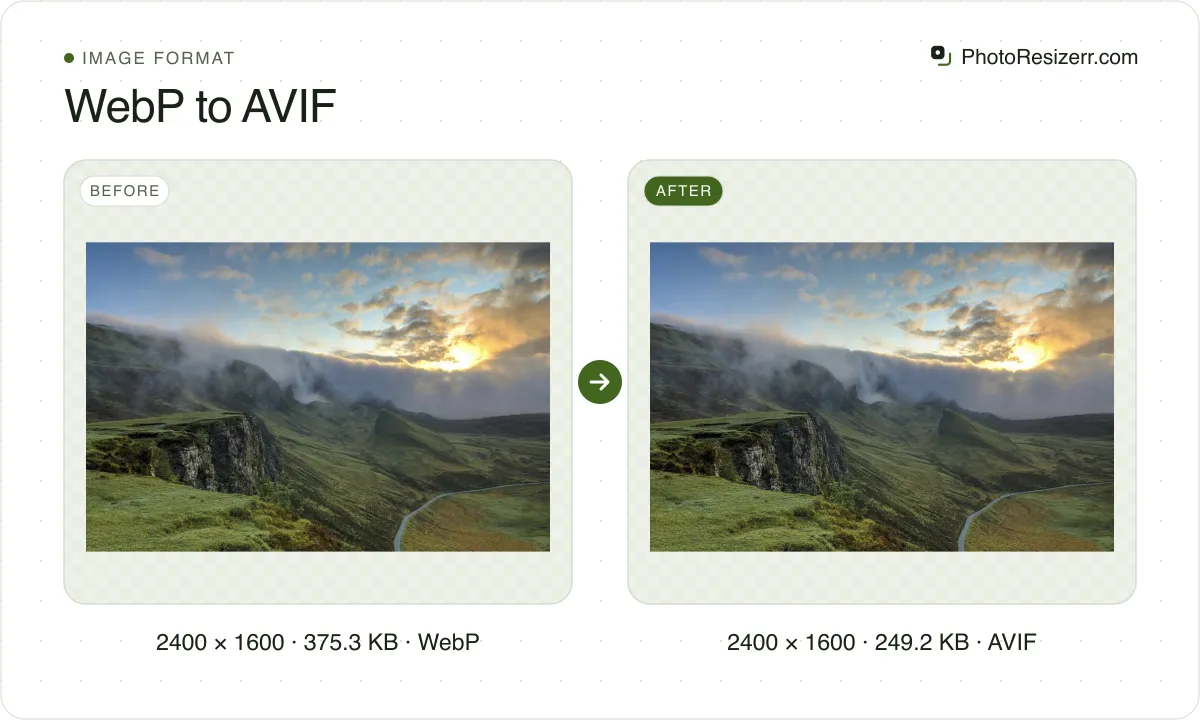
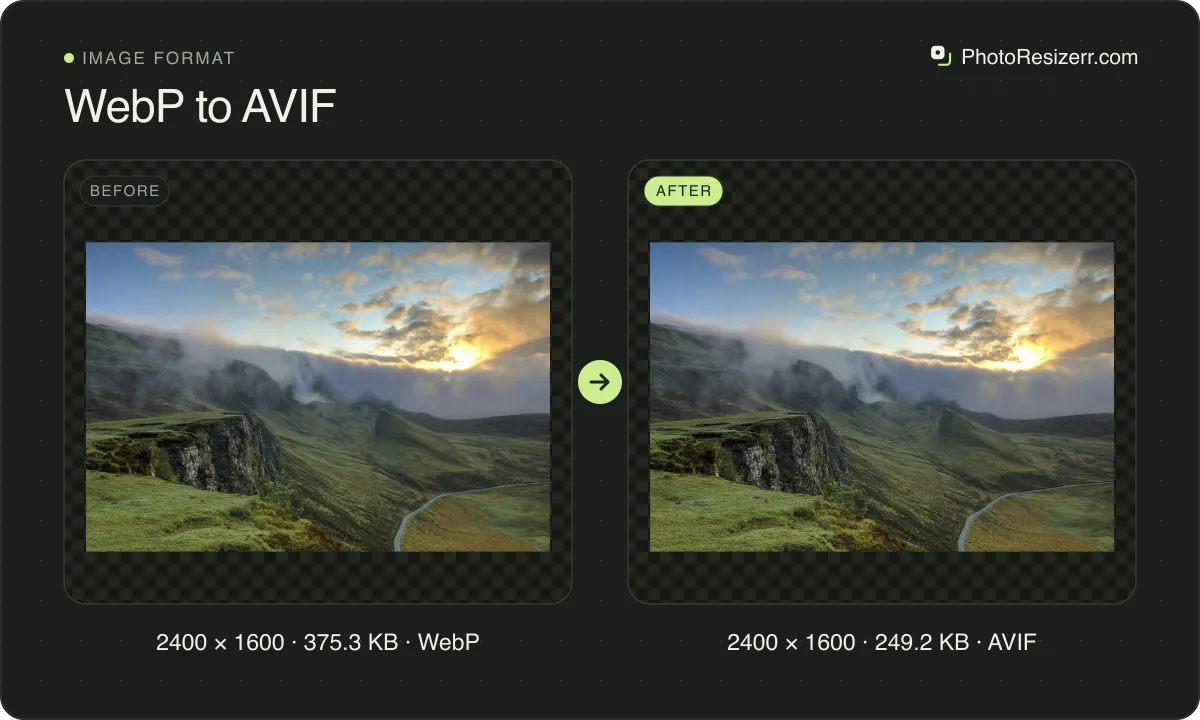
This pair is worth testing rather than assuming: on this site's own sample photo, WebP came out smaller than AVIF at the same quality number. Compare the two file sizes before you commit. Nothing is uploaded.
Why make this conversion?
AVIF and WebP are both modern web formats, so this conversion is a choice rather than a rescue.
AVIF holds up better at very low quality and on smooth gradients, while WebP often wins at ordinary quality. The only reliable answer is to convert and read the two file sizes.
How much does the file size change?
We saved the same seven images, five photographs and two graphics, as WebP and as AVIF with this converter, at its default quality of 82. Only the format changed.
| Image | WebP (KB) | AVIF (KB) | Change |
|---|---|---|---|
| Waterfall in forest | 903 | 1,256 | +39% |
| Cityscape with signage | 1,075 | 1,580 | +47% |
| Sunflower, blurred background | 268 | 389 | +45% |
| Mountain range and sky | 467 | 648 | +39% |
| Waterfall, close crop | 274 | 320 | +17% |
| Screenshot of a web page | 34 | 36 | +5% |
| Share card with text | 24 | 23 | -1% |
On the five photographs, AVIF came out 17 to 47 percent larger than WebP.
How close each format stayed to the original is in JPG vs PNG vs WebP vs AVIF, measured.
A conversion never improves a picture
Changing the format changes how the pixels are stored, not what they show. Detail an earlier save discarded is gone, and no later format can work out what used to be there.
If the original file still exists, convert from that instead.
Where it does matter is the order of the work. Resize and crop first, convert last.
Every save to a lossy format costs a little quality, so the fewer round trips a file makes, the better it looks when you are finished.
What happens to your photo?
Your selected photo is processed in your browser, without an image upload to a server. The page may download code and codecs needed for editing.
Save your result before closing the tab; unsaved edits are kept in memory rather than in an online account.
Common questions
Which is actually smaller, WebP or AVIF?
It depends on the picture and the quality setting, and the honest answer is to try both.
Measured here on one photograph at quality 82, WebP landed at 73 KB and AVIF at 156 KB. A different image, or a lower quality setting, can reverse that.
Is there any reason to move from WebP to AVIF?
Two. AVIF holds together better at very low quality, where WebP starts to look blocky, and it handles skies and other smooth gradients with less banding.
If your WebP already looks right at the size you need, there is nothing here to gain.
Do browsers support AVIF as widely as WebP?
Not quite. WebP works essentially everywhere, while AVIF arrived later and older browser versions still in use will not display it.
On a page you control that matters less than it once did, but WebP remains the safer default if you cannot test.
Last updated: